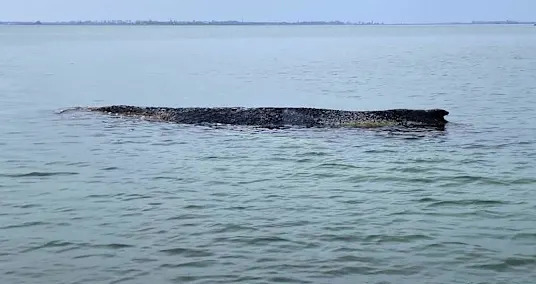
A humpback whale stranded for days off Germany's Baltic coast has gotten stuck on another sandbank, a Greenpeace spokeswoman told dpa on Saturday.
The unlucky animal has garnered massive media attention since it ran aground on a sandbank early on Monday off Germany's Timmendorfer Strand resort, near the city of Lübeck.
Days of efforts to free the 12- to 15-metre whale proved unsuccessful until rescuers dug out a channel in the surrounding sand using a floating excavator on Thursday, allowing the whale to swim free the following night.
However, environmentalists and marine experts had feared that the whale could potentially get stuck again, as it was spotted heading back towards shallower water following its release.
Those fears became reality on Saturday, with the whale spotted stranded on a sandbank in the Bay of Wismar, some 40 kilometres to the east of Timmendorfer Strand, according to Greenpeace.
Incidentally, it was found beached off the unpopulated island of Walfisch, which translates as whale in English.
"After managing to free itself from its [earlier] predicament, the whale was spotted again at midday today in the Bay of Wismar near the island," said a spokesman for the Environment Ministry of the state of Mecklenburg-Vorpommern.
Following initial sightings on Saturday, a plethora of concerned officials, scientists and activists had headed to the Bay of Wismar in case the creature needed assistance again.
Besides Greenpeace activists, water police from the cities of Wismar and Rostock, staff from the German Oceanographic Museum and the Institute for Terrestrial and Aquatic Wildlife Research (ITAW) were on hand both at sea and on land and are assessing the situation, according to the ministry.
Large whales such as humpback whales are not native to the Baltic Sea but occasionally end up there after following schools of fish in search of food, for example.
According to experts, underwater noise could also play a role in this whale's presence in the Baltic Sea.
Biologists had been hoping the whale would make its way back west towards the North Sea, which would have allowed it to reach the open waters of the Atlantic Ocean.
Following its initial release, conservation groups used dinghies to form a kind of blockade to prevent it from entering shallow water again, trying to guide it further into the deeper waters of the Baltic Sea.
However, the whale was soon spotted further east, off the coast of the Mecklenburg district.
According to the ITAW's Stephanie Gross, it was impossible to attach a tracking device to the whale because its skin is too diseased.

latest_posts
- 1
 Tributes pour in for James Ransone, 'The Wire' actor who died at 46
 - 2Aspect Biosystems receives funding for cellular medicine project
- 3Reconnecting with an old friend is a story of distance, loss and rediscovery
- 4Key Training: Picking a Significant for Monetary Achievement
- 5What were the little white pills found in Tiger Woods's pocket at the scene of his crash? What to know about hydrocodone.





- Surveys of Music Collections by Film Stars
- US FDA panel to weigh bid to market nicotine pouches as lower-risk than cigarettes
- 7 Fast Approaches to Let loose Space on Your Telephone in a flash
- See the 'amazing' photos of Earth taken on historic Artemis II moon mission
- Nutrient Rich Natural products: Lift Your Wellbeing
- Many European nations want Israel to cancel 19 new settlement plans
- NASA's Artemis 2 pilot Victor Glover listens to 'Whitey on the Moon' every Monday. This is why.
- People can't get enough of this couple's Hallmark movie reviews. They don't know the painful backstory.
- Flu surges across U.S. as doctor visits reach highest level since 1997