When you buy through links on our articles, Future and its syndication partners may earn a commission.

CAPE CANAVERAL, Fla. — As NASA's giant Artemis 2 moon rocket lifted off Wednesday evening (April 1) from the Space Coast, Jews across the globe were beginning the holiday of Passover, sitting around tables for the traditional meal, called a Seder, and recounting the story of Moses and freedom from slavery in Egypt.
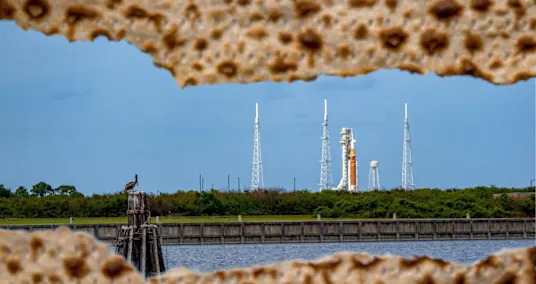
Here at the press site at NASA's Kennedy Space Center, hundreds of journalists showed up for the launch of Artemis 2, which is sending four astronauts on a 10-day journey around the moon. And while it has been a busy day at KSC, a few of the Jewish members of the press (myself included) paused to recognize the holiday with a mini Seder of our own.
We snacked on some Matzah, the traditional unleavened bread eaten on Passover, and remarked on our shared heritage and the convergence with a launch as important as Artemis 2.
As we stood outside a few hours before liftoff, we traded a gamut of Passover puns as Artemis 2's Space Launch System (SLS) rocket stood off in the distance. We read excerpts from an (admittedly AI-generated) Artemis edition of a Passover Hagadah, the book that outlines the order and readings of the meal. And we wondered, Why is this rocket different from all other rockets?
The question echoes the first of four essential questions that are posed during the Passover Seder, which asks, "Why is this night different from all other nights?" In the case of Artemis 2, the answer is the moon. It has been more than 50 years since NASA launched a crew of astronauts to the moon, and the SLS is the only vehicle currently in operation capable of launching people beyond low Earth orbit.
"Our ancestors fled Egypt with dough that had no time to rise. Freedom came suddenly," our Hagadah read. "You have to be ready to move when the window opens. There are no launch windows that wait for yeast."

Artemis 2 is flying NASA astronauts Reid Wiseman, Victor Glover and Christina Koch, as well as Canadian astronaut Jeremy Hansen, on the first crewed mission to lunar space since the end of the Apollo program in 1972, and the first crewed mission of NASA's Artemis program. It's designed as a test flight for Orion's life support systems in deep space.
The mission is a precursor to future Artemis launches that will rehearse rendezvous and docking maneuvers with the program's lunar landers, and eventually land astronauts on the lunar surface.
Unlike Apollo, NASA is using Artemis to go back to the moon to stay. NASA plans to build a lunar base near the moon's south pole beginning in 2032, where crews can maintain a continuous presence for exploration and research, similar to how astronauts live and work aboard the International Space Station.
"On Passover, we talk about what it means to be a Jew," said Planetary Society Science Editor Asa Stahl during the Seder. "During the launch of Artemis, we talk about what it means to be human."
latest_posts
- 1
 An Ideal Getaway - Spots for Solo Travel
 - 2Instructions to Back Your Sunlight powered chargers: Tracking down Possible Choices
- 3Experience Is standing by: History's Most noteworthy Travelers
- 4Baidu robotaxi outage in Wuhan caused by 'system failure', police say
- 5OECD: Iran war dampening global growth




- 7 Powerful Techniques to Boost Efficiency with Your Cell Phone: A Far reaching Guide
- 6 Web-based Course Stages for Successful Learning and Educating
- Step by step instructions to Contrast Lab Precious stones and Normal Jewels
- Hamas delegation meets Egypt’s spy chief amid mutual ceasefire violation claims
- Video of clashes over purported conscription orders misrepresented as anti-war protest in Israel
- British Columbia's Secret Lakeside Town With Hot Springs Is 'An Oasis Of Arts, Culture And Relaxation'
- Historical mysteries solved by science in 2025
- Eurasian cargo hub expands to capture Europe-Asia freight flows
- French and Malaysian authorities are investigating Grok for generating sexualized deepfakes